Chinese research team achieves breakthrough in terahertz key technology to support the development of new generation wireless communication and other technologies
Beijing, January 22 (Xinhua)
(Reporter)
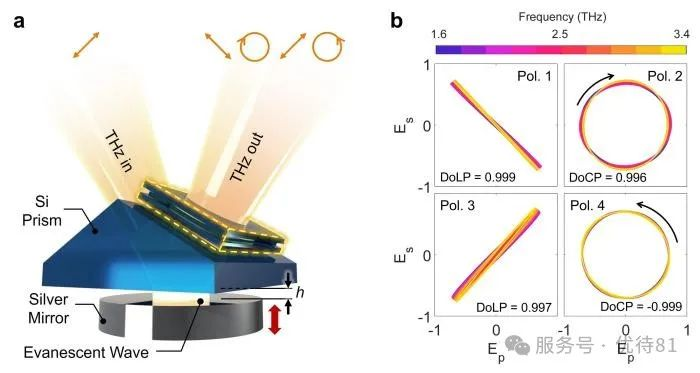
Sun Zifa) The Aerospace Information Innovation Institute of the Chinese Academy of Sciences (CASI) announced to the media on January 22 that its research team has successfully achieved high-precision dynamic regulation of ultra wideband terahertz polarization through innovative technology. This key technological breakthrough will help promote the development and application of terahertz in new generation wireless communication, non-destructive testing of cultural relics, and biological microsensors, playing a unique role in fields such as electronic information, cultural heritage, and life and health. Terahertz multifunctional broadband polarization modulator. (a) Provide a schematic diagram of the device structure; (b) Output the four polarization states measured in the experiment. As an important achievement in the field of terahertz research and application, the pictures provided by the Aerospace Academy of Chinese Academy of Sciences were jointly completed by the research team led by Chen Xuequan and Fang Guangyou, researchers of the Aerospace Academy of Chinese Academy of Sciences, and the team led by Wu Jingbo, a professor of Nanjing University. The relevant research papers were recently published in the professional academic journal Optica. The corresponding author of the paper, researcher Chen Xuequan, introduced that terahertz (THz) waves are located between microwave and infrared in the electromagnetic spectrum, and related technologies have received a lot of attention and developed rapidly in the past 20 years. Meanwhile, terahertz has been widely applied in many disciplines due to its unique physical properties. For example, the large bandwidth of terahertz waves is the foundation for future 6G high-speed wireless communication; Terahertz waves can penetrate and resolve many optically opaque materials with excellent horizontal and vertical resolution, making it another new non-destructive testing technology after X-rays and ultrasound, with unique advantages in manufacturing, pharmaceutical industry, archaeology and other fields; The high sensitivity of terahertz waves to the relaxation of water hydrogen bond networks, molecular vibrations, and carrier concentrations makes them an indispensable tool in biomedical, chemical, and physical research. In most of the aforementioned applications, the polarization state of terahertz waves is a key control parameter, and polarization describes the temporal variation of electric field vibrations. Chen Xuequan explained that the electric field vibration of light waves is like a rope in the hands of artistic gymnasts, which can swing up and down, left and right, as well as rotate clockwise and counterclockwise. Polarization modulators play the role of athletes, creating vastly different motion trajectories. However, actively controlling the polarization of terahertz waves poses significant challenges, mainly due to two natural characteristics of terahertz waves. Firstly, the wavelength of terahertz waves ranges from hundreds of micrometers to millimeters, which is nearly three orders of magnitude higher than visible light, making it difficult for conventional materials to achieve efficient modulation; Secondly, the extremely wide bandwidth of terahertz waves (0.1 to 10 terahertz) requires devices to have very low dispersion response characteristics, which places high demands on the structure. This is like in gymnastics, where the rope needs to make large swings while also having the ability to change speed up to 100 times, "Chen Xuequan further explained. In response to the challenging problem, the research team achieved a wide range of phase control between terahertz p-polarized and s-polarized light in this study by adjusting two key parameters of the polarization modulator - the metal mirror prism distance and the liquid crystal birefringence - with extremely low color difference while maintaining almost unchanged light reflection intensity. This means that the two fundamental dimensions of polarization can be flexibly controlled to output any polarization state, with a relative bandwidth exceeding 90%. The research team pointed out that compared to other known terahertz polarization modulators, their successfully developed terahertz polarization modulator has achieved significant performance breakthroughs in multifunctionality, large operating bandwidth, and high control accuracy. It can provide advanced polarization resolution capabilities for spectral detection, meet the needs of material physical property research, biopharmaceutical quality monitoring, and other applications. It can also serve as a core component of next-generation information technology, reducing transmission losses and improving data throughput in high-speed communication. (End)