
COLORADO: A HIGH GROUND FOR INCLUSIVE AND OPEN CRYPTO TECHNOLOGY ENTERPRISES
 Author | TaxDAO Carlton
1. Introduction to Colorado State
Colorado, abbreviated as Colorado, is located in the western United States, spanning the eastern Rocky Mountains. It has an area of approximately 268000 square kilometers and a population of approximately 5.77 million (as of 2020), ranking 8th in area and 21st in population among the 50 states in the United States. The capital of the state is Denver, which is also the largest city in the state. Due to its abundant natural resources and diverse economic structure, Colorado occupies an important position in the United States.
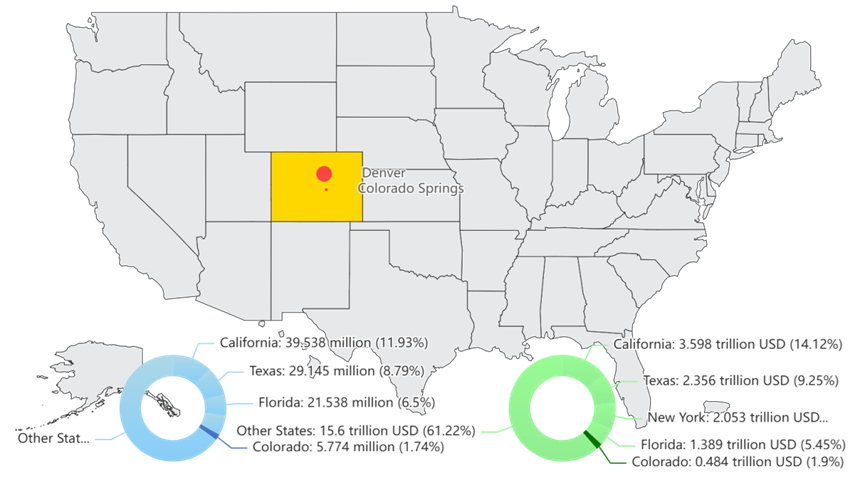
(self-made chart, data source: Wikipedia, Colorado)
In 2022, the total economic output of Colorado is approximately $484 billion, accounting for 1.9% of the US GDP. The economic development of Colorado has strong diversity, mainly including six pillar industries: aviation, aerospace, biotechnology, energy, financial services, and information technology software. The high-tech industry in the state is highly developed, especially in cities such as Denver and Boulder, where a large number of technology innovation companies such as Oracle, Bloomberg, and Newmont Mining have gathered. Colorado is also an important agricultural state in the United States, with major agricultural products including beef, wheat, and corn. In addition, with famous natural landscapes such as the Rocky Mountains, Colorado has become a world-renowned tourist destination, attracting millions of visitors every year.
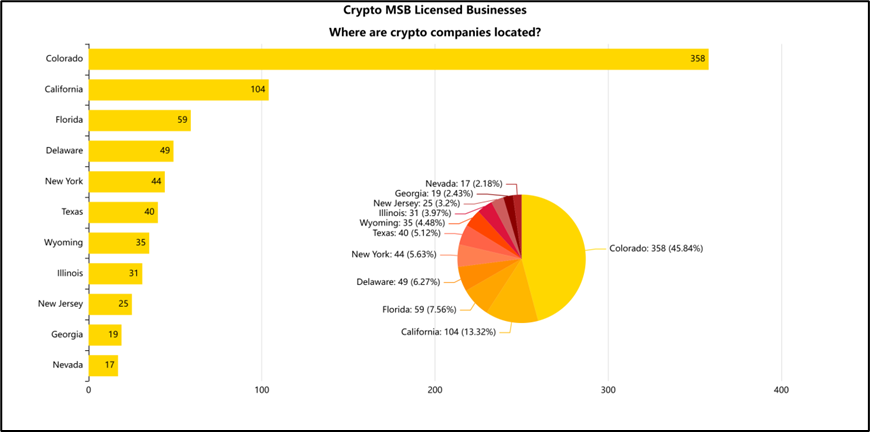
(self-made chart, data source: FinCEN Cryptocurrency Enterprise Registration)
Colorado is a relatively small state in the United States in terms of area, population, and economic aggregate, but its position in cryptocurrency activities is extremely important. According to data from the Financial Crime Enforcement Network (FinCEN), Colorado accounts for approximately 33% of registered cryptocurrency companies in the United States. From an analysis perspective, this phenomenon is mainly attributed to Colorado's active policy support, relaxed regulatory environment, and advantages in energy and industry, among which the assistance of key figures is also indispensable. Next, we will analyze in detail Colorado's specific performance in these areas and how it has driven the state to become an important center for the cryptocurrency industry.


2. Basic tax system in Colorado
The tax system in Colorado is characterized by simplicity and uniformity. Compared to some states' complex progressive tax systems, Colorado adopts a single tax rate that remains consistent for both individuals and businesses, making the state's tax system simple and transparent. Overall, Colorado's tax burden is at a moderately low level, especially in terms of income tax and sales tax rates, which are competitive nationwide.
2.1 Tax types and rates
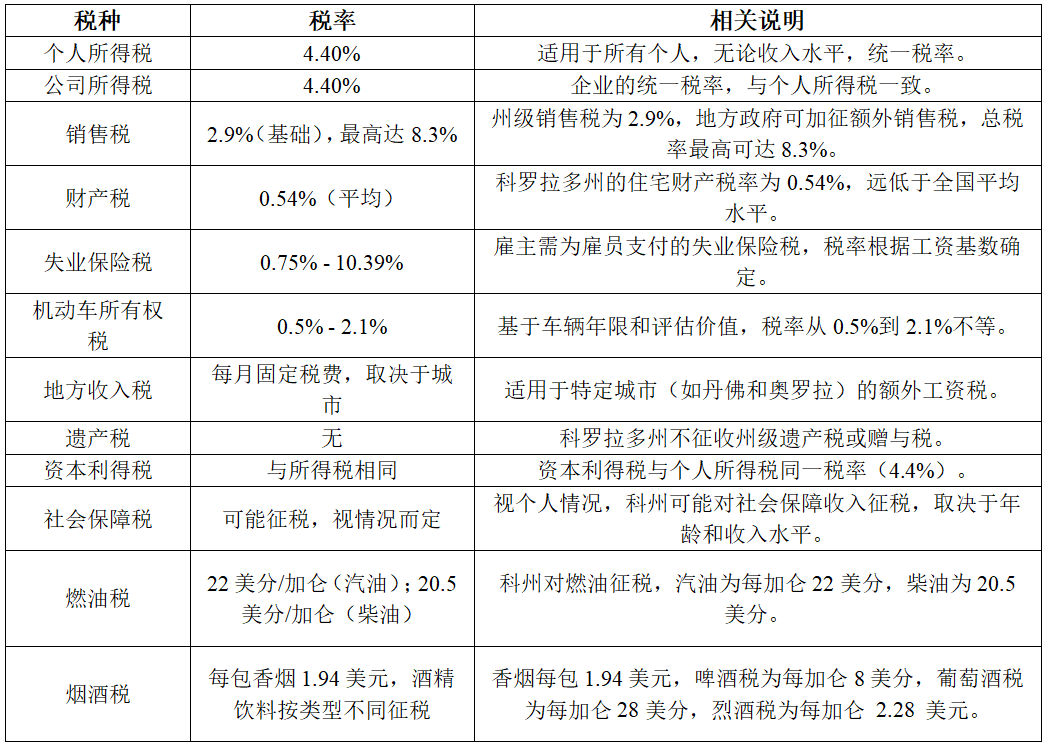
There are currently 11 major types of taxes on the official website of Colorado, such as income tax, land tax, sales and use tax, etc. The summary of some tax categories and tax rates is as follows:
2.2 Taxpayers
Under the tax system in Colorado, taxpayers include individuals, businesses, and other legal entities, and the tax burden is reflected in multiple aspects.
Individuals in Colorado are required to pay a state-level personal income tax rate of 4.4%, which is the uniform tax rate in Colorado and applies to individuals of all income levels. In addition, individuals are required to pay state-level sales tax when purchasing goods and certain services, with a basic tax rate of 2.9%. Local governments can also impose additional taxes, making the total sales tax rate in certain areas reach 7.78%. If an individual owns real estate (such as residential or commercial real estate), they are required to pay property taxes levied by local governments. The average property tax rate in Colorado in 2023 is about 0.54%, which is relatively low compared to the national level.
For businesses, Colorado levies a uniform income tax of 4.4%, which applies to all businesses regardless of their size or income. In addition, companies are required to collect and pay sales tax on the sale of goods and services, which applies to most physical goods as well as some digital goods (such as software, online services, etc.). Colorado also imposes a motor vehicle ownership tax on corporate vehicles, with tax rates adjusted based on the age and assessed value of the vehicles. Although there is no franchise tax or similar corporate tax other than corporate income tax in Colorado, companies still need to declare their income and sales tax to ensure compliance with legal requirements.
2.3 Taxable objects
Colorado's taxation targets include goods, services, capital gains, and specific industries, with a wide range of tax types. The income of individuals and enterprises, sales of goods, real estate, movable property, specific services, etc. are all included in the tax system, forming a relatively comprehensive tax collection framework. In this system, local taxation is combined with state-level taxation to ensure a reasonable distribution of taxation for different economic activities and industries, and a relatively balanced tax burden for enterprises and individuals.
Product: Colorado imposes a sales tax on most tangible goods, with a state-level tax rate of 2.9%, which is one of the lowest base tax rates in the United States. The taxation of goods includes common commodities such as daily consumer goods and clothing. In addition, local governments can impose additional tax rates, making the total sales tax rate in certain areas reach 7.78%. The property tax in Colorado targets real estate for individuals and businesses, including residential, commercial, and vacant land. The average tax rate for property tax in 2023 is approximately 0.54%.
Services: Although many services are not taxed in Colorado, certain services are still classified as taxable objects. Taxable services include repair services, digital services (such as software subscriptions, streaming services), entertainment services, and cable television services. In addition, with the expansion of the digital economy, Koshu has also begun to impose taxes on an increasing number of virtual goods and services, such as cloud computing services and other online platform services. For enterprises providing taxable services, they must collect and pay sales tax on their behalf to ensure compliance with state regulations.
Capital gains: Colorado taxes the income and capital gains of individuals and businesses at a uniform 4.4% tax rate. Personal wages, salaries, interest income, and dividend income, as well as business income of enterprises, are all subject to taxation under the category of capital gains. Capital gains tax (such as income from the sale of assets such as stocks and real estate) is also levied according to the standards of personal income tax.
Real estate and transportation: Colorado imposes a motor vehicle ownership tax on vehicles owned by individuals and businesses.
Specific consumer goods: Colorado imposes special consumption taxes on certain specific consumer goods, such as fuel, tobacco, and alcohol.
2.4 Tax incentives
According to the official website, Colorado has a wide range of tax incentives, including 24 categories. As a state with a lower tax burden, Colorado attracts investors and residents through a series of incentive measures and creates a favorable operating environment for businesses. This includes advanced industry investment tax credit, employee stock ownership tax credit, enterprise contribution tax credit, personal welfare tax credit, etc.
2.4.1 Tax incentives for enterprises
For businesses, Colorado offers a variety of incentives, including capital investment, research and development innovation, and industry-specific tax credits. Firstly, Colorado's Enterprise Zone Program provides significant tax incentives for businesses investing in economically underdeveloped areas. Enterprises can enjoy sales tax refunds, equipment procurement reductions, and other investment tax credits by expanding capital investment and hiring new employees in these areas.
Colorado also has significant tax incentives for renewable energy projects and research and development activities. If enterprises invest in renewable energy fields such as wind and solar energy, they can enjoy tax exemptions for equipment procurement and installation, greatly reducing initial costs. For research and development enterprises, the state government provides R&D Tax Credit to support their investment in technological innovation and high-tech fields. These tax credits encourage companies to establish research and development centers in Colorado and promote the development of green energy and high-tech industries.
In order to further support technological innovation, Colorado has also established the Advanced Industries Accelerator Program. This fund provides direct financial support and tax incentives to enterprises in the fields of aerospace, medical equipment, energy technology, and more. Through this fund, companies can obtain research and development funds and enjoy tax exemptions, especially in promoting cutting-edge technology and innovative product development.
In addition, Colorado provides capital investment incentives for capital intensive investments. If enterprises make long-term capital investments within the state, such as building new factories or expanding production lines, they can receive corresponding investment tax exemptions.
2.4.2 Tax incentives for individuals
For individuals, Colorado also offers various tax incentives. Firstly, the unified income tax rate in Colorado is 4.4%, which is relatively low and concise, applicable to residents and non residents of all income levels, reducing the tax burden on individuals. In addition, Colorado provides partial exemptions for social security income, with individuals aged 55 to 65 being exempt from $20000 in social security income, and individuals aged 65 and above being fully exempt from taxes. This policy is particularly attractive to retirees and elderly residents, reducing their tax burden.
Colorado also provides property tax exemptions for specific groups of people, especially the elderly and disabled. Eligible residents can apply for property tax refunds to help them alleviate the financial burden of property ownership.
3. Taxation and Regulatory System for Cryptocurrency Assets
According to a report by Business Facility on business location selection in 2023, Colorado ranks second in "green jobs," only sixth in "best business environment," "technical talent," and other rankings. In addition, areas such as "best business tax environment," "professional labor training," and others are even absent from the list. From the perspective of the overall tax environment, Colorado does not seem to have the same low tax rates as Texas. Why is the state so attractive for registering money service businesses (MSBs)?
Colorado has always been at the forefront of creating a crypto friendly legal framework, which may explain the state's appeal to MSBs. The state has introduced the Digital Token Act, which provides certain state securities law exemptions for cryptocurrencies, potentially making it easier for blockchain and cryptocurrency focused businesses to operate. Below, we will provide a more detailed introduction to the state's taxation and regulation of the cryptocurrency industry.
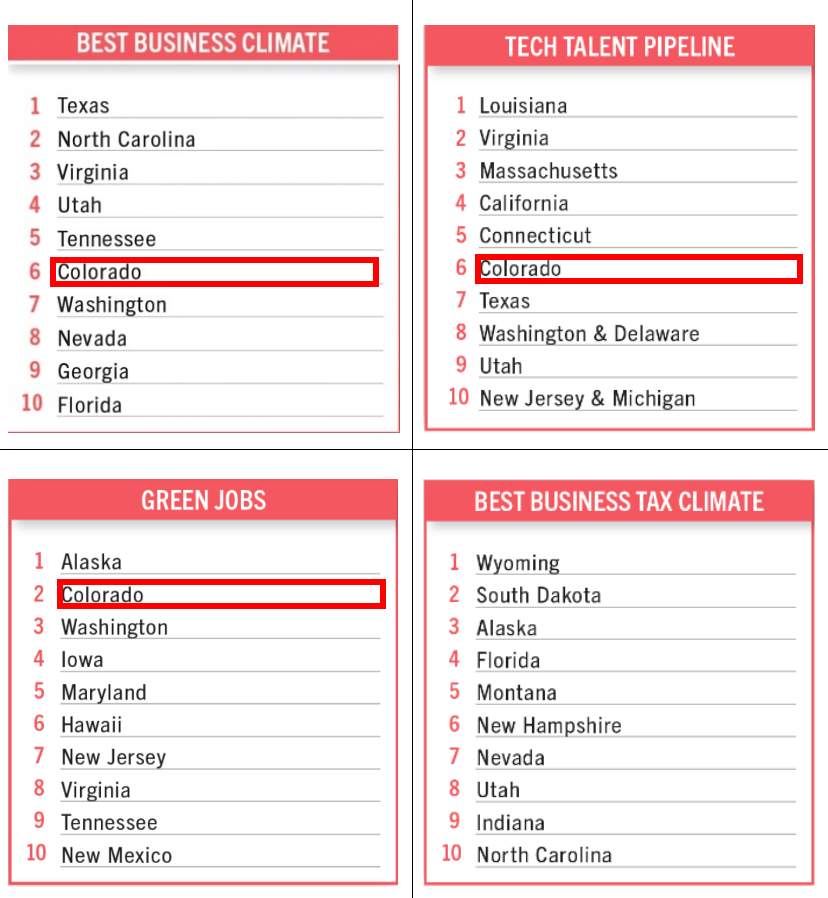
(Source of chart::Business Facilities’ 19th Annual Rankings Report: State Rankings)
Before introducing Colorado's cryptocurrency tax and regulatory framework, we must first mention Governor Jared Polis. He was elected as the Governor of Colorado in November 2018 and officially sworn in in in January 2019. He has been re elected since then. He is an important example of a tech entrepreneur entering politics, and Polis has shown a strong interest in cryptocurrency and blockchain technology during his tenure as a member of Congress, becoming a co-founder of the Congressional Blockchain Caucus. He is committed to making Colorado a center for blockchain innovation. As early as the election period, he publicly and explicitly proposed five policy goals, including promoting the widespread application of blockchain in business and government, developing blockchain infrastructure for election security, simplifying government services, and providing legal and financial framework support for cryptocurrency enterprises. Among them, his insistence on the "Digital Token Law" has further provided a broader entrepreneurial environment for cryptocurrency companies by relaxing securities regulations on certain tokens.
He is also committed to making Colorado the first state in the United States to accept cryptocurrency payments for state taxes, and his goal goes beyond that. He also suggests allowing the use of cryptocurrency to pay for services such as driver's licenses and hunting. We have reason to believe that Colorado's ability to quickly become the forefront of blockchain innovation in the United States is inseparable from his election and promotion.
3.1 Taxation of Cryptocurrency Assets
3.1.1 Definition
Colorado does not have a special tax specifically targeting cryptocurrency assets in terms of taxation. Consistent with the policy of the US federal government, Colorado treats cryptocurrencies as property and applies tax rules similar to capital assets such as stocks and real estate. Therefore, when it comes to cryptocurrency trading or sales, individuals and businesses must declare capital gains tax or capital losses, rather than reporting under other tax categories. The capital gains tax of cryptocurrencies is divided into long-term capital gains and short-term capital gains based on their holding time, which are subject to different tax rates. The short-term tax rate is higher, while the long-term tax rate is relatively lower.
3.1.2 Tax types and rates involved in encrypted assets
The lack of a special tax specifically targeting cryptocurrency assets means that the taxation of cryptocurrency assets in Colorado is based on the basic tax system.
Capital gains tax: If the holding period of cryptocurrency is less than one year, the resulting gains will be considered short-term capital gains and taxed at the ordinary income tax rate for individuals or businesses. The personal ordinary income tax rate in Colorado is 4.4%, while the federal tax rate is tiered based on individual income and can reach up to 37%. If the holding time of cryptocurrency exceeds one year, long-term capital gains tax applies. The long-term capital gains tax rate at the federal level is 0%, 15%, or 20%, depending on the taxpayer's income level. The long-term capital gains tax rate is usually lower than the short-term capital gains tax rate, which encourages investors to hold cryptocurrencies for the long term.
Sales tax: In Colorado, when using cryptocurrency for transactions of goods or services, the payment behavior of cryptocurrency is no different from that of legal tender. After accepting cryptocurrency payments, merchants need to declare the transaction amount at the equivalent exchange rate of US dollars and pay the corresponding sales tax. The basic tax rate for state sales tax is 2.9%, but with the increase of local taxes (such as municipal and county taxes), the actual total tax rate can reach 7% to 11%. Therefore, using cryptocurrency to purchase goods or services in daily consumption does not exempt the obligation to pay sales tax. Similarly, buying and selling cryptocurrencies as commodities also requires paying sales tax.
Paying Taxes: Colorado is the first state in the United States to allow residents and businesses to use cryptocurrency to pay state taxes. Starting from 2022, individuals and businesses can pay personal income tax, corporate tax, and other taxes through third-party platforms using cryptocurrencies such as Bitcoin and Ethereum. These cryptocurrencies will be instantly converted into US dollars through payment processing institutions, and state governments will not directly hold cryptocurrencies. This policy reduces transaction costs while providing more payment options for cryptocurrency users.
Business tax: When businesses conduct cryptocurrency related business in Colorado, their profits must comply with state and federal business tax policies. For corporate income, the corporate income tax rate in Colorado is 4.4%, which is consistent with the tax rate applicable to ordinary businesses. Whether a company makes profits through cryptocurrency exchanges, mining, or other related businesses, it ultimately has to pay business tax based on the corresponding corporate income.
For individual miners or independent cryptocurrency service providers, Colorado requires reporting income and paying taxes in accordance with various tax regulations. Firstly, the cryptocurrency income obtained by individuals through mining will be considered taxable income and estimated based on the market value of the cryptocurrency at the time of mining. This portion of income is subject to personal income tax in Colorado, with a tax rate of 4.4%. At the federal level, this portion of income is subject to federal income tax based on the size of the income. In addition, if an individual sells or uses cryptocurrency obtained from mining for trading, their capital gains are subject to capital gains tax.
In addition, individual miners or self-employed cryptocurrency practitioners are also required to pay a self employment tax, which includes social security tax and medical insurance tax, with a total tax rate of 15.3%. For those who earn income through mining or blockchain services, this tax burden is particularly important. If individual miners or independent practitioners operate on a large scale and hire employees, they also need to consider payroll taxes, including federal and state social security and health insurance taxes, as well as withholding and paying personal income tax.
For cryptocurrency mining companies or blockchain service companies, tax liabilities are more diverse. The profits of enterprises are subject to corporate income tax in Colorado, and after generating profits through mining or blockchain services, the profits obtained from selling cryptocurrencies by enterprises are also subject to capital gains tax. Similarly, if a company uses imported equipment or equipment purchased from other states for mining or providing services without paying local sales tax, the company is required to pay consumption tax. The tax rate of consumption tax varies by region, usually between 7% and 11%. Enterprises providing digital services or cryptocurrency trading platforms may be subject to sales tax on their service revenue, particularly for consumers within Colorado.
3.1.3 Tax incentives
Based on IMF statistical analysis, by 2022, cryptocurrency mining and data centers together will account for 2% of global electricity demand. This proportion may climb to 3.5% within three years, equivalent to the current electricity consumption of Japan, the world's fifth largest electricity user.
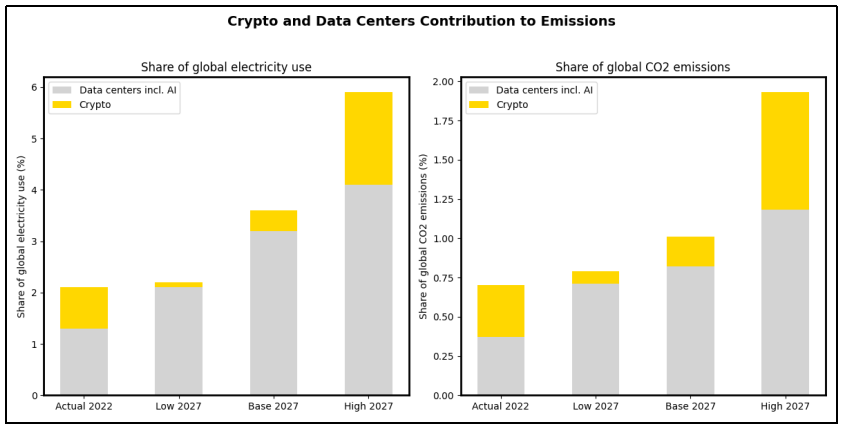
(Chart self-made, original image:Chart of the Week,MACRO-FISCAL POLICY Carbon Emissions from Al and Crypto AreSurging and Tax Policy Can Help)
Cryptocurrency mining and blockchain technology are highly dependent on data centers and a large amount of energy, and like quantum computing and AI, they are industries with extremely high demand for electricity and computing resources. Colorado, as a potential technology hub in the United States, demonstrates strong support for the high-tech industry. In the field of quantum technology, the Governor of Colorado announced a series of new tax credit incentives at the Mountain West Quantum Enhancement Summit in Denver, such as providing tax credits for purchasing equipment and establishing next-generation computing laboratories, and developing loan guarantee programs to help startups obtain funding, aimed at attracting quantum technology companies to settle in.
Similarly, the cryptocurrency industry can benefit from local tax incentives when developing in Koshu - although this policy is not entirely targeted at the cryptocurrency industry. For cryptocurrency miners and enterprises, the following tax incentives should be noted:
Property tax exemptions: According to Section 30-11-132 of Colorado's Local Government Act, local governments can encourage businesses to make long-term capital investments in specific areas by providing property tax exemptions or refunds. Cryptocurrency mining enterprises belong to this type of capital intensive project due to their reliance on large-scale data centers for high-intensity calculations. By signing agreements with local governments, these enterprises can receive property tax exemptions for up to 10 years. Usually, these exemption policies apply to investment projects identified as "Area of Specific Local Concern", aimed at promoting local economic development.
Research and Development Expense Deduction: Colorado Revised Act § 31-20-101.7 provides important tax incentives for businesses engaged in technological innovation. This policy allows companies to use 25% of their R&D expenses to offset their state taxes. This is particularly important for the cryptocurrency industry, especially for companies dedicated to developing new blockchain applications, improving mining efficiency, and optimizing encryption algorithms. By applying for R&D tax credits, cryptocurrency companies can partially offset their expenditures on technology research and development against taxes, reducing their financial burden.
Cryptocurrency payment for taxes: Colorado has become the first state in the United States to allow taxpayers to use cryptocurrency to pay state taxes. Although this does not directly reduce taxes, the use of cryptocurrency payments can provide more tax payment convenience for enterprises whose main wealth is digital assets. This applies to various types of taxes such as income tax, sales tax, and usage tax.
3.2 Regulation of Cryptocurrency Assets
3.2.1 Development History
Compared to Colorado's tax policies, its extensive regulatory system and open innovation business environment are more attractive to cryptocurrency companies. The regulatory changes regarding cryptocurrencies in Colorado have gone through the following periods:
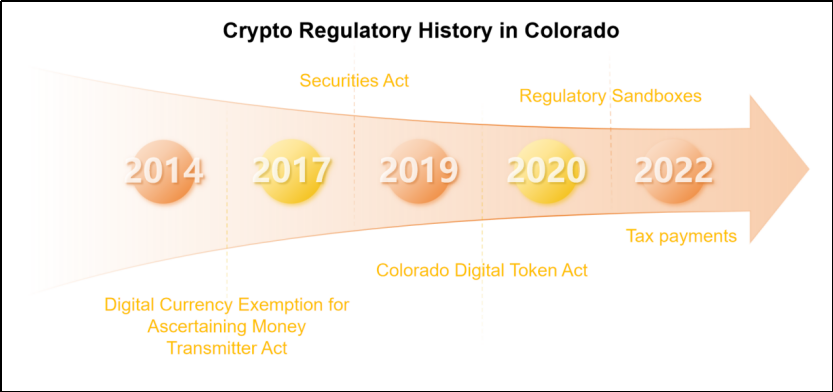
(Chart self-made, content: Development history of Colorado crypto regulatory events)
As early as 2014, Colorado passed the Digital Currency Exemption Act for Determining Currency Transfers, which stipulates that businesses that only handle digital currencies (such as Bitcoin) do not need to apply for a currency transfer license. However, if the enterprise still deals with traditional currencies or acts as an intermediary between buyers and sellers of digital currencies, it must obtain a currency transfer license.
In 2017, Colorado began to pay attention to the legal framework for cryptocurrency, when the state government first recognized cryptocurrency as a commodity and regulated it under the Colorado Securities Act. At this point, the state requires all businesses engaged in buying, selling, or transferring cryptocurrencies to obtain a fund transfer license to ensure compliance with federal regulations such as anti money laundering (AML) and know your customer (KYC).
In 2018, the Colorado Department of Securities released guidelines on how existing securities laws apply to cryptocurrency issuance. Companies and individuals offering cryptocurrency investments in Colorado must comply with state securities registration requirements and disclose all relevant information to potential investors.
In 2019, Colorado passed the landmark Colorado Digital Token Act, which exempted certain encrypted tokens from requirements for securities registration and broker licenses. This provides a more relaxed environment for blockchain and cryptocurrency startups, promoting the development of the industry. It aims to promote innovative applications of blockchain technology and clarify the regulatory scope of digital assets.
In 2020, Colorado established a fintech sandbox program that allows cryptocurrency companies to test new products and services in a controlled regulatory environment. This not only provides more innovation space for cryptocurrency and blockchain companies, but also ensures that enterprises can develop under supervision, avoiding heavy regulatory burdens.
Starting from 2022, businesses and individuals can use cryptocurrency to pay state taxes, including income tax and sales tax. This policy marks a unique breakthrough in the state's acceptance of cryptocurrency across the United States, encouraging more businesses and individuals to use digital currency within a legal framework.
It is not difficult to see that Colorado's regulation of the cryptocurrency industry is proactive and progressive. We have reason to believe that in the future, the state's legal provisions will continue to be updated, and the regulatory environment and cryptocurrency usage will continue to improve.
3.2.2 Regulatory entities
The cryptocurrency regulatory framework in Colorado is primarily based on state laws and regulations, as well as guidance from federal agencies such as the Internal Revenue Service (IRS) and the Securities and Exchange Commission (SEC).
It mainly includes:
Currency Transfer Act: Any individual or entity engaged in currency transfer (including virtual currency transfer) must obtain permission from the Colorado Department of Banking.
The Cheque Sales Law stipulates that the sale or issuance of currency instruments such as cryptocurrencies must comply with sales laws. The Uniform Electronic Transactions Law (UETA) recognizes electronic signatures and records, which may include transactions involving digital assets.
The Colorado Securities Act: The sale or issuance of securities (including certain types of cryptocurrencies) must comply with the Act, register with the Colorado Securities Commissioner, or obtain exemption qualifications.
The Digital Token Act and its amendments: exempt certain securities laws and regulations for digital tokens in the state, making it easier for companies to raise funds through initial coin offerings (ICOs) or other digital token issuances; Senate Bill 20-109 adds additional consumer protection measures, requiring businesses seeking exemptions under the bill to disclose their token offerings and submit annual reports to the Colorado Securities Commissioner
And guidelines from the Securities Department, the Internal Revenue Service, the Securities and Exchange Commission, etc
Colorado has not yet developed a comprehensive regulatory framework specifically for cryptocurrencies. But existing state laws and federal guidelines play an important role in regulating the cryptocurrency industry in the state. The government agencies that play a role include:
The Colorado Department of Securities is responsible for regulating the sale and issuance of securities, including certain types of cryptocurrencies.
Colorado Department of Regulatory Agencies (DORA): DORA regulates various industries in the state and designates the Securities Department to oversee cryptocurrency activities.
Colorado Department of Taxation: The Department of Taxation manages and enforces taxation, including income tax on cryptocurrency transactions.
Colorado Banking Commission: The State Banking Commission regulates and supervises state chartered banks, trust companies, and other financial institutions that handle virtual currencies.
Banking Department: As part of DORA, the banking department supervises state chartered credit cooperatives and trust companies that provide virtual currency exchange services.
Office of the Attorney General - Consumer Protection Division: The Consumer Protection Division investigates complaints related to virtual currency fraud or deception.
3.2.3 Regulatory Objects
Under the gradually improving regulatory system in Colorado, the regulated objects are also more diverse, including:
Cryptocurrency exchange and wallet service providers: The platform helps users buy, sell, and store cryptocurrencies. According to federal regulations and Colorado state laws, exchanges must comply with fund transfer laws and obtain a fund transfer license. These enterprises require AML and KYC regulations to ensure that transactions are legal and compliant.
Digital token issuing companies: According to the Digital Token Law, companies issuing digital tokens are exempt from some securities laws when their tokens are used for consumption (rather than investment), but still subject to basic anti fraud legal regulation. These types of enterprises need to ensure that token issuance does not involve investment fraud and complies with relevant consumer protection regulations at the time of issuance.
Cryptocurrency miners and mining facilities: Mining companies are directly regulated by securities or financial regulations when trading encrypted assets, and due to their high energy consumption characteristics, cryptocurrency mines are indirectly regulated by state energy policies and environmental regulations. Mining sites must comply with relevant commercial and tax regulations to ensure legal and compliant operations.
Fintech and blockchain startups: In Colorado, many fintech companies use blockchain technology for innovation. Companies participating in the fintech sandbox program are testing new technologies and products with less regulation, providing regulatory support and innovation space for cryptocurrency related startups, but must also comply with basic consumer protection and privacy regulations.
Individual or institutional users: If individuals and institutions engage in cryptocurrency transactions, especially investment transactions, they need to declare capital gains tax or other related taxes at the state or federal level.
4. Summary and Prospect
Colorado, with its open policies and regulatory framework, has become a leader in the cryptocurrency industry in the United States. The state has effectively reduced the operating costs of high-tech enterprises, including cryptocurrency companies, through flexible policies such as property tax reductions, research and development tax credits, and equipment investment incentives, providing substantial support for capital intensive and high energy consuming mining activities. In addition, legal provisions represented by the Digital Token Law simplify compliance processes, provide compliance guidance, and encourage innovative development. The regulatory system covers a wide range, from exchanges to mining enterprises, ensuring the standardized operation of the cryptocurrency ecosystem.
With the continuous expansion of the blockchain and cryptocurrency markets, Colorado is expected to continue to demonstrate its innovative leadership. In the future, Koshu may attract more global leading cryptocurrency companies to settle down by expanding tax incentives and optimizing its fintech sandbox program. At the same time, with the increasing demand for energy use and environmental protection, Koju may implement more green energy incentives in high energy mining enterprises to balance industry growth and environmental responsibility. This will further consolidate its national leading position in the fields of blockchain and encrypted assets.