
Johnson was re-elected as Speaker in the dramatic vote of the House of Representatives
From: Qiao Bao News, America Online
Republican Mike Johnson won reelection by a narrow margin in the first round of the House Speaker election on January 3 after convincing two Republicans who initially voted against him. The Republican Party has now won a majority in both houses of Congress and is preparing for President-elect Donald Trump to move into the White House later this month. According to the Associated Press, before the vote began, a small group of hard-line Republicans gathered at the back of the House chamber, refusing to vote or choosing to support other members. Johnson's expression was very serious at the time, and the situation forced him to admit that new turmoil within the Republican Party was coming, which also foreshadowed the trouble Johnson faced after Trump returned to the White House and took control of a unified Republican government in Washington. But in the end, Johnson successfully persuaded two Republicans who had opposed him to support him, winning applause from Republicans. The final vote was 218 to 215, and all Democratic House members voted for House Minority Leader Hakeem Jefferies.
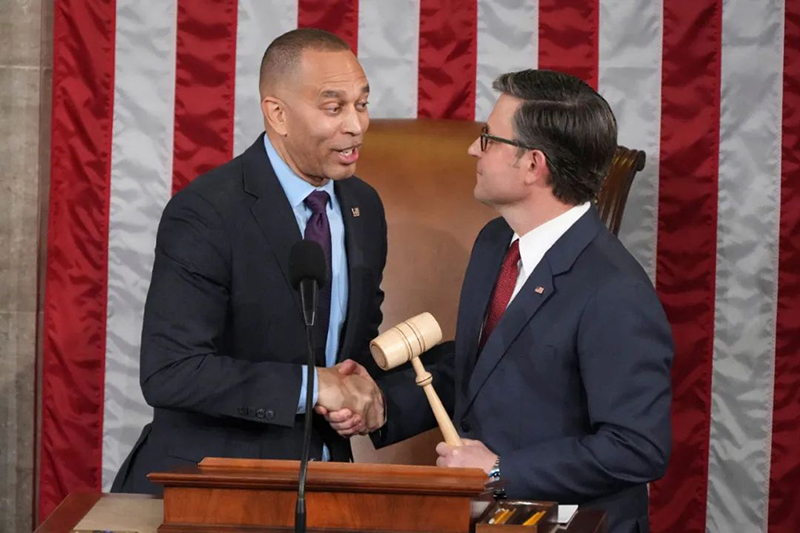
House Minority Leader Jeffries, a Democrat, shakes hands with House Speaker Johnson, a Republican, after handing the mace to him in a customary recognition of the peaceful transfer of power. The House of Representatives meets at the Capitol on January 3, 2025 to elect the Speaker and convene the new 119th Congress. (Photo: Associated Press)
In his re-election speech, Johnson vowed that he would "reject business as usual" after the Republicans took power. He promised: "We will significantly reduce the size and functions of government." President-elect Trump later posted on social media to congratulate Johnson on his re-election, saying that "our country will be the beneficiary." The Associated Press pointed out that Johnson's weak control over the speakership not only threatens his own political survival, but also threatens Trump's grand agenda centered on tax cuts and mass deportations. The narrow margin of the vote exposed the challenges he will face. Even with Trump's backing, there is no guarantee that Johnson can keep the speakership. House Democratic leader Jeffries tried to overcome the chaos caused by internal conflicts in the Republican Party in the past two years in the House of Representatives, calling on all parties to unite, put party politics aside, and "do practical things for the American people." January 3 was originally the day when newly elected members were sworn in, and they usually attended with their families, friends and children. This year's Inauguration Day has evolved into a high-stakes vote for the speakership of the House, one of the most powerful positions in Washington, and Republican members wore long red ties similar to Trump's style to vote. Vice President Kamala Harris swore in the senators. While the Senate was able to convene on its own and had already chosen party leaders - Sen. John Thune as Republican majority leader and Sen. Chuck Schumer as Democratic minority leader - the House must first choose its speaker, a constitutional position that is second in the presidential succession line. So the election of the speaker of the House has become a major issue at the start of the new Congress. The new Congress will also produce a batch of history-making members, and the Senate is expected to soon begin hearings on Trump's nominees for cabinet and senior administration positions. In the Senate, two black women - Lisa Blunt Rochester of Delaware and Angela Alsobrooks of Maryland - were sworn in, both wearing suffragette white suits, marking the first time in U.S. history that two black female senators have been inaugurated at the same time. New Jersey Sen.-elect Andy Kim also made history as the first Korean American in the Senate. In the House of Representatives, Sarah McBride is the first openly transgender member of Congress.